The Project

MODELS & ADVANTAGES OF PERSONALIZED MEDICINE

The project was created with the intention of responding to the growing demand for personalized medical services in the clinical, diagnostic and pre-clinical fields, in a context in which the contraction of available economic resources and the aging of the population necessitate the adoption of more efficient, more targeted approaches, to ensure the economic sustainability of the system and quality of assistance.

Thanks to the development of new materials and the use of state-of-the-art printing technologies, it will be possible to create anatomical models with mechanical and functional characteristics similar to those of their natural counterparts.

The original imaging approaches developed will make it possible to merge the virtual and physical realization of complex organs in a single platform.

PRINTMED-3D is therefore laying the foundations for the construction of a personalized medicine model, which enables the programming and planning of the various phases of surgical interventions, improving the effectiveness of treatments, decreasing the risks for the patient and reducing operative and post-operative times.

L’utente utilizza un dispositivo all-in-one per la realtà virtuale immersiva.
Photo: Marco Ferrari
3D reconstruction from CT sections of abdominal organs for visualization in an immersive virtual reality environment
Mold for reproducing the liver's anatomy, manufactured using additive technologies with photopolymer resin-based materials
Photo: Marco Ferrari

Create something new

Study of additive printing and possible applications

PRINTMED-3D arose from the meeting of two visionary researchers, both working at the University of Milan: Paolo Milani, Full Professor of Structure of Matter and Director of the Interdisciplinary Center for Nanostructured Materials and Interfaces (CIMaINa), and Gian Vincenzo Zuccotti, Full Professor of General and Specialized Pediatrics and President of the Management Committee of the Faculty of Medicine and Surgery.

Their encounter with Alessandro Rotilio, a serial entrepreneur with acknowledged experience in the field of medical technologies and founder of several innovative start-ups, then opened the doors to new collaborations with important industrial players.

From this union of physicists, clinical doctors and entrepreneurs, a project idea was developed, leading to the creation of a network of public and private entities renowned in the field of medical innovation and additive printing. The project, winner of the Lombardy Region’s “Call Hub Research and Innovation” tender, was supported by the European Regional Development Fund (POR FESR) 2014-2020 with a contribution of 3,163,089.29 euros, highlighting the strategic importance attributed to it.

PRINTMED-3D is a project that brings together complementary skills from both an academic and an industrial perspective, finding their ideal synthesis in a partnership that sees the University of Milan as the coordinating body, reinforced by the involvement of the Department of Physics, the Interdisciplinary Center for Nanostructured Materials and Interfaces (CIMaINa), and the Faculty of Medicine and Surgery, along with the “Carlo Besta” Neurological Institute Foundation, an Italian Research Hospital that participates with the Department of Neurosurgery and with the Besta NeuroSim Center (BNSC), and various innovative companies such as Dolphin Fluidics, NRGsys, Intelligenza Trasparente and Kentstrapper.

Anatomical liver model obtained from a patient's CT scan, reproducing the mechanical consistency and intraparenchymal distribution of hepatic veins, thanks to the use of tissue-equivalent polymeric materials developed within PRINTMED-3D
Photo: Marco Ferrari
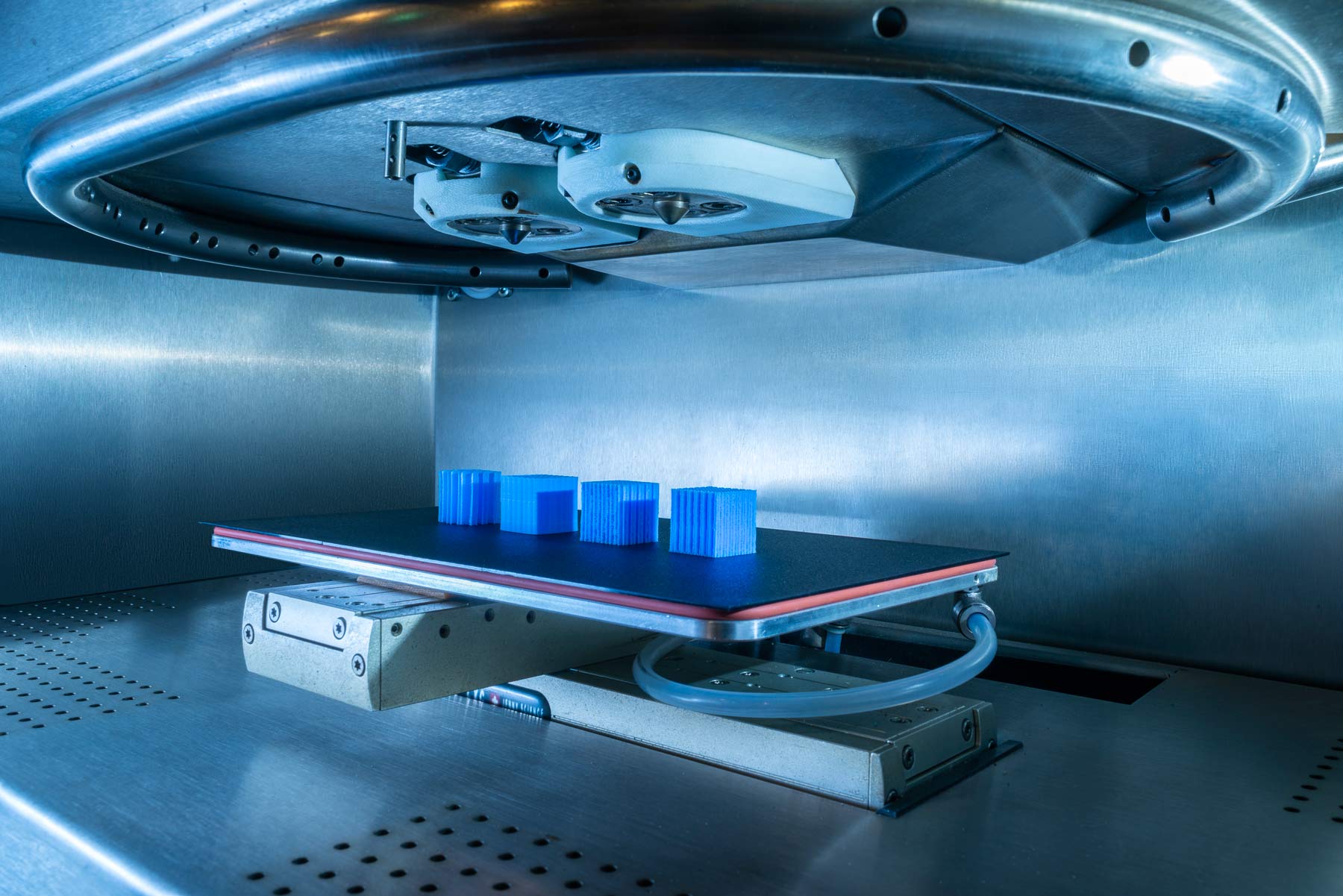
Extrusion printing chamber for soft materials (Arburg GmbH)
Photo: Marco Ferrari
Model of intrahepatic portal branches manufactured using additive printing for extracorporeal perfusion simulation.
Photo: Marco Ferrari

Models of concreteness

Benefits and objectives

PRINTMED-3D represents a concrete opportunity for the creation of a Lombard competence center for three-dimensional medical technologies, which will have substantial repercussions on the regional health system, on training and professional medical specialization itineraries and on the creation of entrepreneurship with high technological value in the biomedical, material science and ICT sectors.

The evolution towards a new model of a personalized approach to medicine will be made possible thanks to the creation of virtual models equipped with a physical equivalent that fully adheres to the functional anatomical reality of the patient, making it possible to simulate complex surgical procedures in a risk-free environment, ethically and repeatably.

The results will be shared regionally in the cloud and will be accessible by Medical Schools and Hospital Departments. In this way, PRINTMED-3D will make a significant contribution to the development of new professional figures and to the creation of a network of researchers with across-the-board theoretical and practical skills in the fields of healthcare, virtual reality and intelligent manufacturing.

Model of the inferior vena cava and hepatic veins obtained from a CT scan and manufactured using additive printing with soft materials to reproduce the mechanical properties of anatomical structures
Photo: Marco Ferrari

Partners